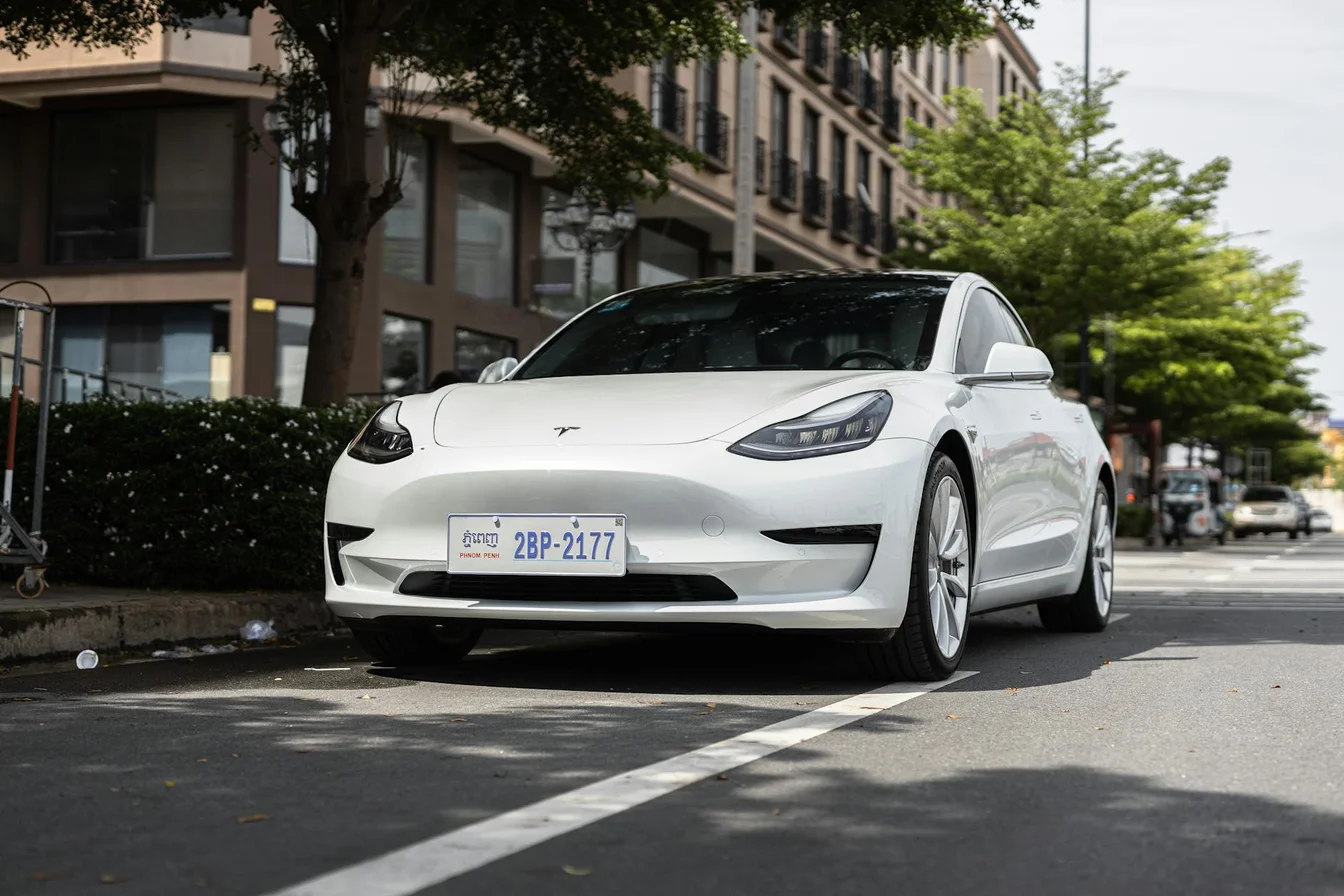

# Is Tesla Stock Overvalued in 2026? A Complete Valuation Analysis
Tesla (TSLA) remains one of the most debated stocks on Wall Street in 2026. With a market capitalization that dwarfs traditional automakers combined, investors continue to ask: is Tesla stock overvalued in 2026? This comprehensive analysis breaks down Tesla's valuation metrics, compares it with tech peers, examines bull and bear cases, and identifies key Tesla beneficiary stocks for 2026.
Tesla's Current Valuation Metrics in 2026
Understanding whether Tesla is overvalued requires examining its fundamental valuation ratios against historical norms and industry benchmarks.
Price-to-Earnings (P/E) Ratio
Tesla's forward P/E ratio currently sits around 60-75x, depending on which analyst estimates you use. While this has come down significantly from the 200x+ levels seen in 2021, it remains substantially higher than:
- S&P 500 average: ~21x forward P/E
- Auto industry average: ~8-12x forward P/E
- Tech sector average: ~28-35x forward P/E
Even by tech standards, Tesla trades at a premium. However, bulls argue this premium is justified by Tesla's growth trajectory and expansion into AI, robotics, and energy.
Price-to-Sales (P/S) Ratio
Tesla's P/S ratio hovers around 8-12x, which tells an interesting story:
| Company | P/S Ratio (2026) | Revenue Growth (YoY) |
|---|---|---|
| Tesla | ~10x | 18-25% |
| Nvidia | ~20x | 40-55% |
| Apple | ~8x | 5-8% |
| Microsoft | ~12x | 12-16% |
Tesla's P/S ratio is lower than Nvidia's but higher than Apple's, positioning it in an interesting middle ground. The key question is whether Tesla's revenue growth justifies this multiple.
Market Cap vs Revenue Analysis
Tesla's market capitalization exceeds $1 trillion in 2026, making it one of the most valuable companies globally. To put this in perspective:
- Annual Revenue: Approximately $120-140 billion
- Market Cap / Revenue: ~8-10x
- Toyota's Market Cap / Revenue: ~0.8x
- Volkswagen's Market Cap / Revenue: ~0.3x
This means Tesla is valued at roughly 10-30x the ratio of traditional automakers per dollar of revenue. The market is clearly pricing in something beyond car manufacturing.
Comparing Tesla with Big Tech Valuations
A fair analysis of Tesla's valuation requires comparing it not just with automakers, but with the tech giants it increasingly competes with.
Tesla vs Nvidia
Nvidia trades at higher multiples than Tesla on most metrics, but Nvidia's revenue growth rate is also significantly higher. Nvidia's dominance in AI chips gives it a clearer path to sustained hyper-growth. Tesla's AI story is compelling but less proven in terms of revenue contribution.
Tesla vs Apple
Apple generates significantly more free cash flow than Tesla and trades at a lower P/E ratio. However, Apple's growth rate is much slower. Tesla bulls argue that TSLA deserves a higher multiple because of its faster growth and larger addressable market (vehicles + energy + AI + robotics).
Tesla vs Microsoft
Microsoft offers a useful comparison because it successfully transitioned from a hardware/software company to a cloud/AI platform. Microsoft trades at a P/E of ~32x with steady 12-16% growth. Tesla would need to demonstrate similar platform economics to justify its higher multiple.
The Bull Case for Tesla in 2026
Tesla optimists point to several catalysts that could justify or even expand the current valuation.
1. Full Self-Driving (FSD) Revenue Potential
Tesla's FSD technology represents potentially the largest software revenue opportunity in automotive history. If Tesla achieves true Level 4/5 autonomy:
- Recurring subscription revenue from millions of vehicles
- Robotaxi network could generate revenue per mile with near-zero marginal cost
- Licensing opportunity to other automakers
- Estimated revenue potential: $50-100 billion annually by 2030
In 2026, FSD is showing meaningful progress. The supervised FSD v13+ has significantly reduced intervention rates, and regulatory approvals are expanding across more states and countries.
2. Optimus Robot Commercialization
Tesla's Optimus humanoid robot could be a multi-trillion dollar opportunity if successfully commercialized:
- Initial deployment in Tesla's own factories (reducing labor costs)
- Enterprise sales to manufacturing, logistics, and healthcare
- Consumer market potential in the 2028-2030 timeframe
- CEO Elon Musk has suggested the robot business could eventually exceed the car business
3. Energy Storage Exponential Growth
Tesla Energy (Megapack, Powerwall) is growing at 50%+ annually and approaching $15-20 billion in annual revenue. The global energy storage market is expected to grow 10x over the next decade, and Tesla is the market leader.
4. AI and Data Advantage
Tesla collects billions of miles of real-world driving data, giving it a potential advantage in:
- Training AI models for autonomous driving
- Understanding traffic patterns and urban mobility
- Developing next-generation neural networks
The Bear Case for Tesla in 2026
Critics raise legitimate concerns about Tesla's valuation that every investor should consider.
1. Auto Industry Competition Intensifies
- BYD has surpassed Tesla in total vehicle sales globally
- Legacy automakers (Mercedes, BMW, Ford, GM) are ramping EV production
- Chinese EV makers (NIO, XPeng, Li Auto) offer competitive products at lower prices
- Tesla's EV market share has declined from 20%+ to approximately 15% globally
2. Margin Pressure
Tesla's automotive gross margins have compressed from 25%+ to approximately 18-20% due to:
- Price cuts to maintain volume growth
- Increased competition requiring more spending on incentives
- Rising raw material costs for battery production
- Higher labor costs at expanding factories
3. Valuation Already Prices in Perfection
At 60-75x forward P/E, Tesla needs to execute flawlessly across multiple business lines. Any stumble in FSD development, robot commercialization, or energy growth could trigger a significant re-rating.
4. Regulatory and Political Risks
- EV subsidies face potential rollback in various markets
- FSD regulatory approval remains uncertain in key markets (EU, China)
- Trade tensions could impact Tesla's China operations
- Antitrust scrutiny of Tesla's vertically integrated model
5. Key Person Risk
Tesla's valuation is closely tied to Elon Musk's leadership and vision. His involvement in multiple ventures (SpaceX, X/Twitter, xAI, Neuralink, government roles) raises questions about bandwidth and focus.
Tesla Beneficiary Stocks 2026: Companies Riding the Tesla Wave
Beyond investing in Tesla directly, savvy investors look at Tesla beneficiary stocks — companies that profit from Tesla's ecosystem growth. Here are the top Tesla beneficiary stocks for 2026:
Tier 1: Direct Suppliers
Panasonic Holdings (PCRFY) — Tesla's longest-running battery cell partner. As Tesla expands production, Panasonic benefits from increased cell orders, particularly the new 4680 format batteries.
ON Semiconductor (ON) — Supplies silicon carbide (SiC) chips for Tesla's inverters and power electronics. Every Tesla vehicle contains hundreds of dollars worth of ON Semi components.
Texas Instruments (TXN) — Provides analog and embedded processing chips used throughout Tesla vehicles for power management, sensing, and control systems.
Tier 2: Infrastructure Beneficiaries
ChargePoint Holdings (CHPT) — As Tesla expands its Supercharger network and opens it to other EVs, the entire EV charging ecosystem grows, benefiting ChargePoint.
Albemarle Corporation (ALB) — The world's largest lithium producer benefits directly from Tesla's increasing battery production volumes. Tesla's Megapack growth is an additional demand driver.
MP Materials (MP) — Supplies rare earth materials critical for EV motors. Tesla's growing vehicle production means more demand for these essential materials.
Tier 3: AI/Robotics Ecosystem
Nvidia (NVDA) — Powers Tesla's AI training infrastructure (Dojo alternatives). As Tesla expands its AI ambitions, GPU demand grows. Nvidia also benefits from the broader autonomous driving trend.
Ambarella (AMBA) — Provides edge AI vision processors used in advanced driver assistance systems. Tesla's FSD success validates the entire ADAS market.
Cognex Corporation (CGNX) — Supplies machine vision systems used in Tesla's factories. More Gigafactories mean more Cognex equipment.
How to Evaluate Tesla's Fair Value
Rather than simply asking "is Tesla overvalued?", consider these valuation frameworks:
Sum-of-the-Parts Analysis
| Business Segment | Estimated Value | Basis |
|---|---|---|
| Auto Manufacturing | $300-400B | 15-20x auto earnings |
| FSD/Autonomy | $200-500B | DCF of future software revenue |
| Energy Storage | $100-200B | Growth-adjusted peer multiples |
| Optimus/Robotics | $50-300B | Highly speculative, option value |
| AI/Data | $50-100B | Strategic asset value |
| Total | $700B - $1.5T | Range reflects uncertainty |
This sum-of-the-parts analysis suggests Tesla's current valuation of ~$1T sits within the range, but the wide spread highlights the uncertainty.
Discounted Cash Flow (DCF) Sensitivity
Tesla's DCF value is highly sensitive to assumptions about:
- Revenue growth rate (15% vs 25% CAGR over 10 years)
- Terminal margins (15% vs 25% net margin)
- Discount rate (8% vs 12%)
Small changes in these assumptions can swing the fair value by hundreds of billions of dollars, which is why analysts have such divergent price targets.
Trading Tesla Stock Tokens: A Modern Alternative
For investors who want exposure to Tesla without traditional brokerage limitations, stock tokens offer compelling advantages:
Why Trade Tesla Stock Tokens?
- 24/7 Trading — React to Elon Musk's late-night announcements or Asian market movements without waiting for NYSE to open
- Fractional Ownership — Buy as little as $1 worth of Tesla, perfect for dollar-cost averaging
- No Traditional Broker Required — Trade directly from your crypto wallet
- Global Access — Available to investors worldwide, regardless of local brokerage restrictions
- Instant Settlement — No T+2 settlement delay
You can buy Tesla stock tokens through platforms like OKX, which offers a comprehensive selection of tokenized stocks. Check out our OKX stock tokens review for a detailed guide on getting started.
Investment Strategies for Tesla in 2026
For Tesla Bulls
- Dollar-cost average into positions using fractional stock tokens
- Consider adding Tesla beneficiary stocks for diversified exposure
- Set clear profit targets and use trailing stops
- Monitor FSD rollout milestones and Optimus development updates
For Tesla Bears
- Avoid outright shorting (unlimited risk with a volatile stock)
- Consider put spreads or bear call spreads for defined-risk bearish bets
- Watch for margin compression as a leading indicator
- Monitor market share trends in key markets (US, China, Europe)
For Undecided Investors
- Start with a small position via fractional stock tokens
- Build a watchlist of Tesla beneficiary stocks
- Set price alerts for key technical levels
- Follow quarterly earnings for margin and delivery trends
Verdict: Is Tesla Stock Overvalued in 2026?
The honest answer is: it depends on which future you believe in.
If Tesla is primarily an automaker, the stock is significantly overvalued at 60-75x P/E. No car company deserves this multiple, regardless of growth rate.
If Tesla successfully scales FSD, energy, and robotics, the current valuation could actually be reasonable or even cheap. The total addressable market for these businesses is measured in trillions.
Our balanced view: Tesla is priced for near-perfect execution across multiple business lines. The stock offers asymmetric upside if the AI/robotics bets pay off, but carries significant downside risk if growth slows or margins compress further. For most investors, a measured approach — using fractional stock tokens to build a position gradually — makes the most sense.
The Tesla beneficiary stocks listed above offer an alternative way to gain exposure to the Tesla ecosystem with potentially less single-stock risk.
---
*Want to start trading Tesla and other US stocks with crypto? Buy Tesla stock tokens with USDT on leading exchanges, or explore Nvidia, Apple, and Microsoft stock tokens for a diversified tech portfolio.*